
17
Days
Best Of Southern Africa
 June to September
- March to May
- October to February
- Small Group Scheduled Tour
- Minibus Quantum or Similar




It begins with a roar. Victoria Falls announces itself long before you see it, a column of mist rising above the rainforest, and a walk beneath the canopy that leaves you soaked, grinning and entirely converted. From there the journey drifts west and south, and Africa slowly changes her voice.
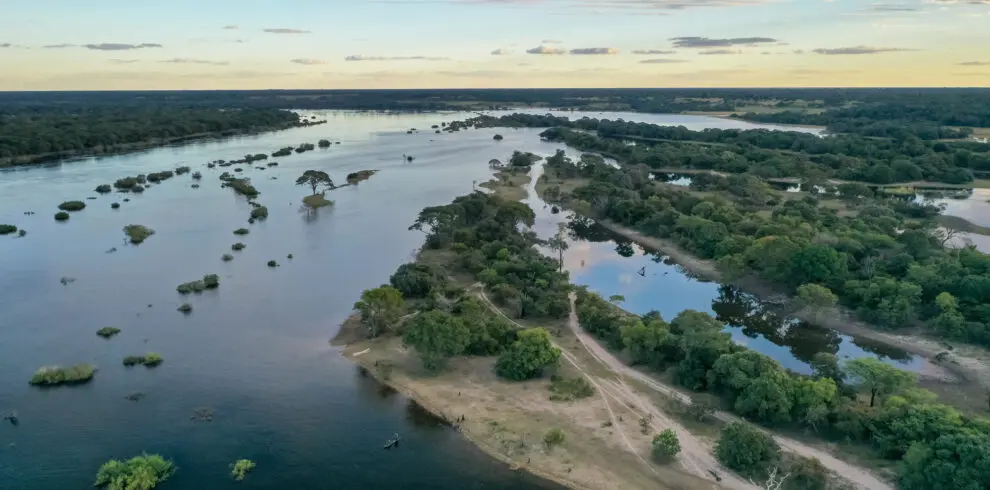
On the Chobe River, elephants wade in by the hundred while the sun turns the water to molten gold. In Namibia's Zambezi Region, lodges sit under riverine trees on the banks of the Kwando and the Okavango, where breakfast is served on a boat and the birdlife is almost showing off. There is a morning with the Khwe Bushmen, a game drive through little-known Mahango, and then a full day in Etosha — that vast white pan where giraffe, zebra, springbok and, if the day is kind, lion gather at the waterholes.
Then the south. Red Kalahari dunes combed with golden grass. The immense, silent gash of the Fish River Canyon. Kolmanskop, a diamond town swallowed by sand. The wild horses of the Namib at Garub. And finally Sossusvlei at first light, where the dunes burn orange and Deadvlei's ancient camelthorns stand frozen against white clay — before the Atlantic appears at Swakopmund and the desert finally exhales.
Sixteen nights, comfortable country lodges, a Namibian guide who knows every story on the road. This is Southern Africa at full, glorious stretch.
- Walk the rainforest at Victoria Falls
- Cruise the Chobe River at sunset
- Meet the Khwe Bushmen of the Caprivi
- Eat breakfast on the Okavango
- Game drive through Mahango National Park
- Spend a full day in Etosha National Park
- Stand on the rim of the Fish River Canyon
- Wander through Kolmanskop
- Look for the wild horses of the Namib at Garub
- Climb into Sossusvlei at sunrise
- Finish beside the Atlantic in Swakopmund
Day 1 :
Victoria Falls, Zimbabwe
Welcome to Zimbabwe. It's a short hop from the airport into town, and by the time you've checked in you'll already have heard it — that low, constant thunder on the edge of hearing. Victoria Falls is a place of tropical gardens, easy hospitality and permanent anticipation. In the afternoon, a guided walk takes you through the rainforest to the Falls themselves, where the spray drifts sideways, the light fractures into rainbows and the camera never quite does it justice. A gentle, spectacular opening.
Included Activities
Guided walk through the rainforest of Victoria Falls and visit to the Falls
Accommodation
Cresta Sprayview Hotel or similar
Route & Distance
Victoria Falls International Airport → Victoria Falls town — 22 km / about 25 minutes
Day 2 :
Kasane, Botswana
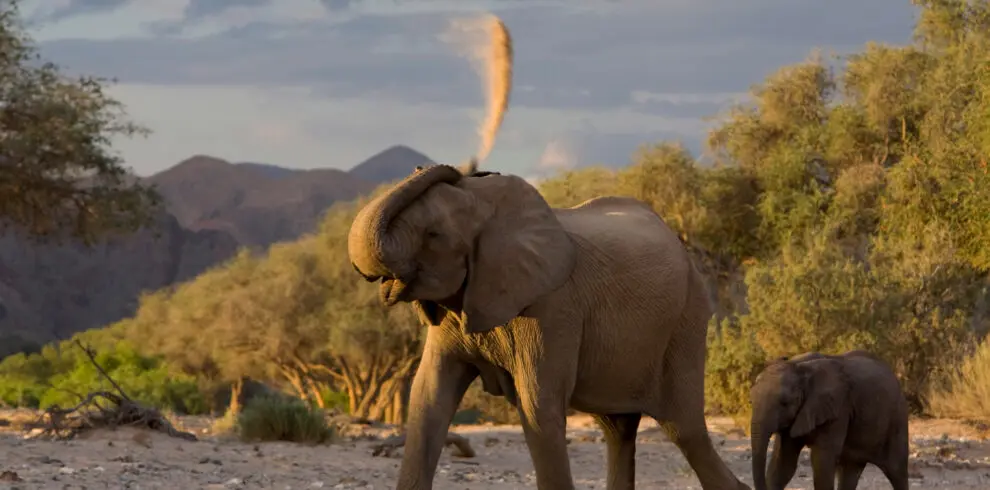
A leisurely breakfast, then the border, and Botswana opens up ahead of you. Kasane sits right on the edge of Chobe National Park, and the afternoon belongs to the river. Gliding out on a boat cruise, you watch the Chobe do what it does best: elephants coming down to drink and bathe in great grey processions, hippos surfacing with a huff, crocodiles stretched out in the sun, birds everywhere. Then the sun drops and the whole river turns gold, amber and crimson. Drink in hand, Africa all around. Dinner back at the lodge.
Included Activities
Boat cruise on the Chobe River
Accommodation
Cresta Mowana Safari Resort or similar
Route & Distance
ictoria Falls → Kasane — 90 km / about 2½ hours (including border formalities)ictoria Falls → Kasane — 90 km / about 2½ hours (including border formalities)
Meals
Breakfast & Dinner
Day 3 :
Kongola, Zambezi Region
West into Namibia, and into a version of the country almost nobody expects: rivers, forest, floodplains and green. The Zambezi Region feels like a secret. Your lodge sits on the banks of the Kwando under towering trees, a riverside retreat where the loudest thing is the birdlife. The afternoon is yours — river views, a book, the slow business of doing very little. As evening comes the water catches the last of the light, dinner is served, and the bush settles into its night sounds.
Accommodation
Camp Kwando or similar
Route & Distance
Kasane → Kongola — 220 km / about 3–4 hours
Meals
Breakfast & Dinner
Day 4 :
Okavango River, Kavango
Wake to the Kwando, then continue west through lush vegetation, winding waterways and open floodplains. This is a road full of small human moments — children waving, fishermen mending nets, villages going about their morning. Today you visit one of them, meeting the Khwe Bushman community of the Caprivi and being properly introduced to the people of this region. By afternoon you're on the Okavango, one of Africa's great rivers, with a lodge deck, gliding birds and softening light. Dinner beside the water, then a sky absolutely crowded with stars.
Included Activities
Cultural visit to the Khwe Bushman of the Caprivi
Accommodation
Rainbow River Lodge or similar
Route & Distance
Camp Kwando → Divundu / Okavango River — 240 km / about 3–4 hours
Meals
Breakfast & Dinner
Day 5 :
Mahango National Park
The gentlest possible start: a breakfast boat cruise on the Okavango, with the first gold light on the water, a hippo surfacing somewhere off the bow and crocodiles laid out along the banks. Keep the camera up — the birding here is world-class. Later you head into Mahango National Park, small in size and enormous in reward. Elephant herds move through the bush, buffalo gather near the water, antelope scatter across the plains, and the bird list climbs all afternoon. One of Namibia's genuine best-kept secrets, explored in safari vehicles.
Included Activities
Breakfast boat cruise on the Okavango River; game drive in Mahango National Park in safari vehicles
Accommodation
Rainbow River Lodge or similar
Meals
Breakfast & Dinner
Day 6 :
Tsumeb
A long, handsome drive south through the middle of Namibia, and a proper lesson in how quickly this country changes its mind. Riverine woodland gives way to open savannah, savannah to horizon. Small settlements come and go, distant mountains hold the edges, and the sky simply keeps going. It's the kind of day where the road itself is the point — wide, quiet and quietly humbling. You arrive in the historic mining town of Tsumeb, settle into the Minen Hotel, and eat well ahead of the safari days to come.
Accommodation
Minen Hotel or similar
Route & Distance
Divundu → Tsumeb — 520 km / about 7 hours
Meals
Breakfast & Dinner
Day 7 :
Etosha National Park
This is the one. A full day travelling through Etosha, one of Africa's great wildlife arenas — a landscape of vast salt pans, bleached grasslands and waterholes that pull everything toward them. Elephants shoulder in at the water's edge. Giraffe drift across the plains in that unhurried way of theirs. Zebra and springbok graze in their hundreds. And with a little luck, lions lying up in the shade, watching it all. Every waterhole is its own small story. You check in outside the park for dinner and a very starry, very quiet night.
Included Activities
Full day game drive in Etosha National Park from the tour vehicle
Accommodation
Toshari Lodge or similar
Route & Distance
Tsumeb → Etosha — 250 km / full-day safari in the tour vehicle
Meals
Breakfast & Dinner
Day 8 :
Windhoek
A final morning in the wild beauty of Etosha, then south through the heart of the country. The salt pans fall away behind you and the drive settles into something reflective — past the farming town of Otjiwarongo, then Okahandja with its celebrated woodcarving markets and deep cultural roots. It's a good day for replaying the week: the elephants on the Chobe, the Okavango at dawn, that first lion. Rolling hills announce the capital, and you arrive in Windhoek in the late afternoon — time enough for the terrace and a golden sunset.
Accommodation
Hotel Thule or similar
Route & Distance
Etosha → Otjiwarongo → Okahandja → Windhoek — 430 km / about 5 hours
Meals
Breakfast
Day 9 :
The Kalahari
The city thins out, and Namibia begins to show you her quieter face: vast space, endless sky, and earth that deepens from dust to red to amber as you travel south through Rehoboth. The Kalahari is a softer desert than the Namib — rolling crimson dunes furred with golden grass, ancient camelthorn trees standing guard. Your lodge is an oasis, and the afternoon is yours for the pool and the stillness. At dusk the dunes glow, oryx, springbok and ostrich move through the low light, and the stars arrive in numbers most people have never seen.
Optional Activities
Sunset nature drive
Accommodation
Kalahari Anib Lodge or similar
Route & Distance
Windhoek → Rehoboth → Kalahari — approx. 340 km / approx. 4 hours
Meals
Breakfast & Dinner
Day 10 :
Fish River Canyon
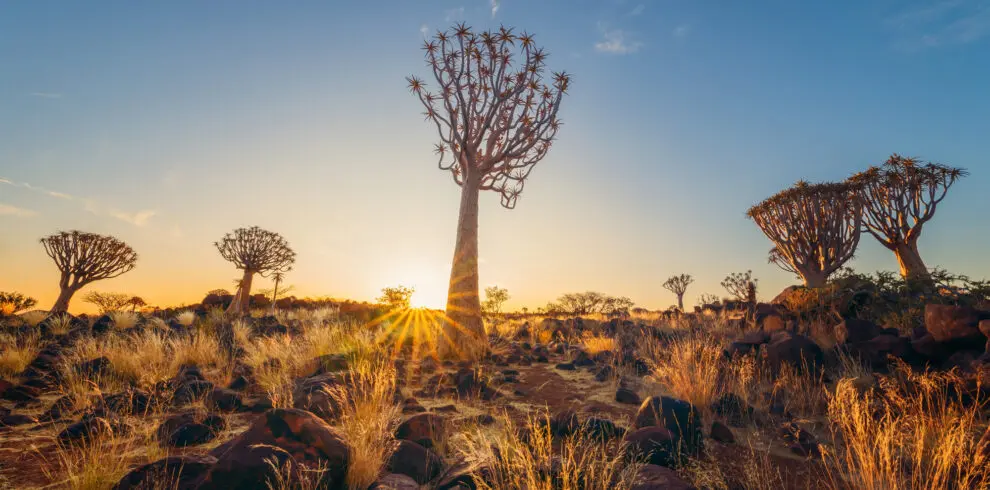
Breakfast in the quiet of the Kalahari, then further south into country that keeps raising the stakes. The route runs via Mariental and on through Keetmanshoop, with stops at the otherworldly Quiver Tree Forest and the tumbled boulders of Giants Playground — a landscape that looks arranged by something enormous and playful. All afternoon the anticipation builds for one of Namibia's headline acts: the Fish River Canyon. You arrive at your lodge to a beautiful setting, a good dinner and the particular hush that settles over the deep south at night.
Included Activities
Quiver Tree Forest and Giants Playground
Accommodation
Canyon Village or similar
Route & Distance
Kalahari → Mariental → Keetmanshoop → Fish River Canyon — 420 km / approx. 6 hours
Meals
Breakfast & Dinner
Day 11 :
Aus
An early start, fresh air and a hearty breakfast before the Fish River Canyon reveals its true scale. Photographs prepare you for none of it — one of the largest canyons on earth, folding away in layer after layer of rock and shadow, with a short walk along the rim to let the size of the thing land properly. Afterwards the road carries you through the captivating emptiness of southern Namibia toward Aus. At your lodge for the next two nights, the silence is profound — the kind that slows time down. Terrace, horizon, thoughts.
Included Activities
Visit and short walk at the second largest canyon in the world, the Fish River Canyon
Accommodation
Desert Horse Inn or similar
Route & Distance
Fish River Canyon → Aus — 320 km / about 4 hours
Meals
Fish River Canyon → Aus — 320 km / about 4 hours
Day 12 :
Lüderitz & Kolmanskop
A day of forgotten dreams and no long distances. Lüderitz arrives like a mirage — German colonial facades in sherbet colours, wedged between wind-scoured rock and the cold Atlantic, a town with a character entirely its own. Then Kolmanskop, where a diamond boomtown has surrendered to the desert: sunlight through broken windows, dunes spilling into ballrooms, silence where daily life once echoed. It's genuinely moving. On the way back to Aus you stop at the Garub waterhole, hoping for the wild horses of the Namib — tough, mysterious, free, and thriving where almost nothing else does.
Included Activities
Guided walk through Kolmanskop, the 'Diamond Ghost Town' of Namibia; Garub, the watering hole of the wild horses of the Namib Desert
Accommodation
Desert Horse Inn or similar
Route & Distance
Aus → Lüderitz → Kolmanskop → Garub → Aus — 240 km / full day excursion
Meals
Breakfast & Dinner
Day 13 :
Toward Sossusvlei
After a leisurely breakfast you turn north, leaving the plains of Aus and the haunting south behind. Today is a day of transition, and Namibia uses every kilometre of it — vast open country, rugged mountain scenery, horizons that keep retreating. The landscape shifts steadily under you, and the sense of anticipation builds with it; this country has a remarkable way of changing its face. You reach the lodge in the soft light of early afternoon. As evening settles and the stars come out, there's a charge in the air: tomorrow is Sossusvlei.
Accommodation
Hammerstein Lodge or similar
Route & Distance
Aus → Sossusvlei region — 320 km / about 6 hours
Meals
Breakfast & Dinner
Day 14 :
Sossusvlei
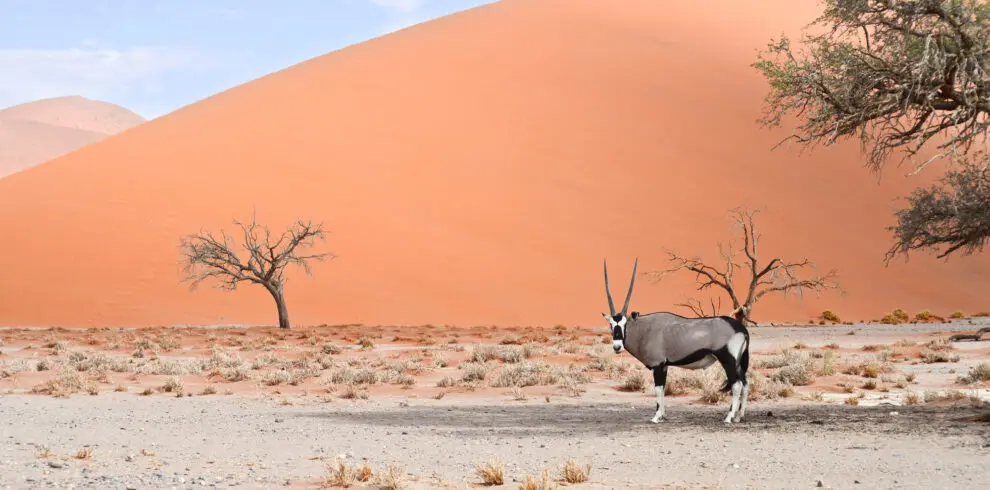
Today starts before the desert does. Coffee in the dark, then out into the cool stillness toward the most famous dunes on earth. You reach Sesriem as dawn breaks and enter the park just after sunrise, when the first light pours across the sand and the dunes ignite — orange, red, impossible. A 4x4 shuttle takes you the last 5 km to Sossusvlei, and then Deadvlei: a blinding white clay pan studded with blackened camelthorn trees, dead for centuries and still standing. Sesriem Canyon follows. Afternoons here are for the pool and doing absolutely nothing.
Included Activities
Excursion to Sossusvlei, the highest sand dunes in the world; 4x4 shuttle for the last 5 km; Deadvlei; visit to Sesriem Canyon
Accommodation
Hammerstein Lodge or similar
Route & Distance
Lodge → Sesriem → Sossusvlei → lodge — 320 km / about 6–7 hour excursion
Meals
Breakfast & Dinner
Day 15 :
Swakopmund
A gentler morning after yesterday's dawn raid, then west, out of the Namib and toward the sea. There's a stop at Solitaire — a speck of a settlement that has somehow become a Namibian institution — for a slice of the apple crumble pie that half the country will tell you about. Then the air changes, the light changes, and the Atlantic appears. Swakopmund is palm-lined streets, colonial architecture and salt on the breeze; after days of desert silence, the sound of surf feels like a welcome. A short sightseeing tour, then check in.
Included Activities
City tour of Swakopmund
Accommodation
Swakopmund Sands Hotel or similar
Route & Distance
Sossusvlei region → Solitaire → Swakopmund — 400 km / about 5–6 hours
Meals
Breakfast
Day 16 :
Swakopmund at Leisure
A day to play or a day to breathe — entirely your call. Swakopmund is the adventure capital of the coast, so there's dune boarding out in the sand sea and catamaran cruises that come back with dolphin stories. Or you can do none of it: stroll the iconic Swakopmund Jetty out over the surf, drift between the cafés and galleries, browse, eat well, and let the ocean air do its work after two weeks of desert and bush. After sixteen days of early starts and big country, an unstructured day by the sea is its own kind of luxury.
Optional Activities
Dune boarding; catamaran cruise with dolphins; Swakopmund Jetty; local cafés and galleries; beach walks
Accommodation
Swakopmund Sands Hotel
Meals
Breakfast
Day 17 :
Return to Windhoek & Departure
A relaxed final breakfast in Swakopmund, and then the scenic drive inland to Windhoek — one last run through Namibian country that has spent sixteen days refusing to repeat itself. Three countries, a waterfall, two great rivers, a salt pan, a canyon, a ghost town, the highest dunes on the planet and an ocean. Not a bad fortnight's work. Here the journey through the south of Namibia comes to a close.
Route & Distance
Swakopmund → Windhoek — approx. 360 km / approx. 4½ hours
-
Available Available PackagesThursdayFebruary 11, 2027SaturdayFebruary 27, 2027USD 7,550Available
-
Available Available PackagesFridayFebruary 26, 2027SundayMarch 14, 2027USD 7,550Available
-
Available Available PackagesSaturdayMarch 13, 2027MondayMarch 29, 2027USD 7,550Available
-
Available Available PackagesSundayMarch 28, 2027TuesdayApril 13, 2027USD 7,550Available
-
Available Available PackagesMondayApril 12, 2027WednesdayApril 28, 2027USD 7,550Available
16 Days
USD 7,150
7 Days
USD 2,880
8 Days
USD 3,990
9 Days
USD 3,680
22 Days
USD 9,750
13 Days
USD 5,150
Frequently Asked Questions
About This Tour
Sixteen overnights in locally standard accommodation, 16 x breakfast and 12 x dinner, comfortable transportation in vehicles typical for the country, fuel and insurance for the vehicle, an experienced Namibian tour guide, and all national park entry fees as per the itinerary. The listed included activities are also covered: the guided rainforest walk at Victoria Falls, the Chobe River boat cruise, the Khwe Bushman cultural visit, the breakfast boat cruise on the Okavango, the Mahango game drive in safari vehicles, the full day game drive in Etosha, the Fish River Canyon visit and short walk, the guided Kolmanskop walk, Garub, the Sossusvlei excursion including the 4x4 shuttle for the final 5 km, Sesriem Canyon, and the Swakopmund city tour.
No. All national park entry fees as per the itinerary are included in the rate, so there's nothing further to budget for at the Etosha, Mahango or Sossusvlei gates.
The tour includes 16 breakfasts and 12 dinners. That means dinner is not included on Days 1, 8, 15 and 16 — Victoria Falls, Windhoek and both nights in Swakopmund — which leaves you free to explore the restaurants in each of those towns. Lunches are not part of the package.
Two days have optional activities built in. In the Kalahari on Day 9 you can join a sunset nature drive, and your full free day in Swakopmund on Day 16 is open to adrenaline activities such as dune boarding, a catamaran cruise with dolphins, or simply the jetty, the cafés and the beach. These sit outside the included services listed above — please ask your consultant to quote them separately.
From
USD 7,550
/ Adult Per Person
From
USD 615
/ Single Supplement
From
USD 8,165
/ Solo Traveller
- Best Price Guaranteed - ( You won't pay more booking direct with us. )
- No Booking Fees - ( No hidden booking fees or markups at checkout. )
- Secure Booking Process
Need help with booking? Send Us A Message