Table of contents
- 1 Is South Africa Known for Good Food?
- 2 Why is Cape Town Seen as a Culinary Capital?
- 3 What World Foods Can You Get in South Africa?
- 4 What Traditional Food Can You Get in South Africa?
- 5 What Sort of Food Do You Have on Safari?
- 6 What Sort of Food Do You Get in Cape Town?
- 7 What Are Famous South African Restaurants?
- 8 What Are Popular South African Dishes and Foods?
Enhance your reading experience—immerse yourself in the adventure with our audio version. Click play and let the sounds of Africa captivate you!
When travelling to a place like South Africa, you probably don’t expect that one of the things you can’t stop talking about when recounting your trip is the food.
South Africa is famous for its wildlife, for its wine and winelands, for having one of the best rugby teams on the planet, and for its incredible, mengelmoes of foods!
Nowhere on Earth makes a stronger first impression, when it comes to food, than South Africa.
If you are one of the lucky ones planning a trip to the southernmost part of Africa, you’ll want to taste as much as you can, and we’re going to help you treat your palate by sharing all the things you need to know about food in South Africa!

Is South Africa Known for Good Food?
South Africa has a well-earned reputation for being one of the world’s most exciting food destinations, and it has the accolades to support that claim.
In the 2024 Condé Nast Traveller Readers’ Choice Awards, Cape Town was named the world’s best city for food, beating out Tokyo, Milan, and Porto.
In 2025, Time Out Travel placed it fourth globally in its annual ranking of culinary capitals, and three Cape Town restaurants appeared on the prestigious World’s 100 Best Restaurants list for 2025.
The reason for food in South Africa being so good has a lot to do with the country’s many cultures and eclectic history.
South African cuisine is shaped by at least eleven distinct cultural influences, which includes indigenous Khoi, San, Xhosa and Zulu traditions, Dutch, French Huguenot and German settlers, Cape Malay cooking brought by enslaved people from Indonesia and Malaysia in the 17th century, and the Indian community whose arrival in Durban in the 19th century gave the country one of its most beloved street foods, the bunny chow!
When dining on good food in South Africa, every plate you tuck into could very well be telling several stories at once, and you might not even realise it.

Why is Cape Town Seen as a Culinary Capital?
Cape Town’s food scene is extraordinary mostly because of the ingredients, many of which can be freshly harvested right on the city’s doorstep, and in part because of the chefs who have grown up here.
The city sits at the intersection of the Atlantic and Indian Oceans, giving it access to some of the finest seafood in the southern hemisphere, and the Winelands lie less than an hour away, supplying Cape Town’s many bars and restaurants with world-class produce, wine, and inspiring a culture of slow, thoughtful eating.
And the city’s layered history, which includes Javanese, Malay, Dutch, French, British, and indigenous African influences, has created a culinary language entirely its own.
As chef Peter Tempelhoff of Fyn restaurant once said, fusion food did not start as a trend here. It is simply what Cape Town has always done, while the rest of the world has merely adopted it.
What World Foods Can You Get in South Africa?
Remarkably, you can get pretty much any food you like, everything from popular American franchise food like KFC to a roadside farm stall made chicken pie that you’ll spend years thinking about and perhaps never get to taste again.
Cape Town in particular is South Africa’s genuinely cosmopolitan food city, with Japanese, Italian, Lebanese, French, Indian, and Pan-African restaurants operating at a very high standard.
The Chefs Warehouse group runs some of the most respected contemporary dining rooms in the country, drawing influences from across the Mediterranean and Asia.
FYN, one of Cape Town’s most celebrated fine-dining restaurants, fuses Japanese techniques with local South African ingredients in a way that has drawn international press attention.
For travellers from the United States, the combination of familiar international cuisines alongside wholly new South African flavours makes the country particularly fun and comfortable as a food destination.
Food in South Africa is an indulgence made with wholesome, just plain good ingredients. In most towns and cities, you’ll be treated to a variety of belly-filling options to keep you fueled during your trip.
What Traditional Food Can You Get in South Africa?
The list is long and so worth working through, whether you are a dedicated foodie or not.
One of the most common foods in South Africa that you’ll come across throughout the country is Bobotie.
It is a national dish that is made using spiced minced meat (usually a curried type of spice mix), which is baked with a silky egg custard topping, sweetened with dried apricots and served with yellow rice and Mrs Balls chutney.
It is comfort food with depth, and the recipe is hundreds of years old.
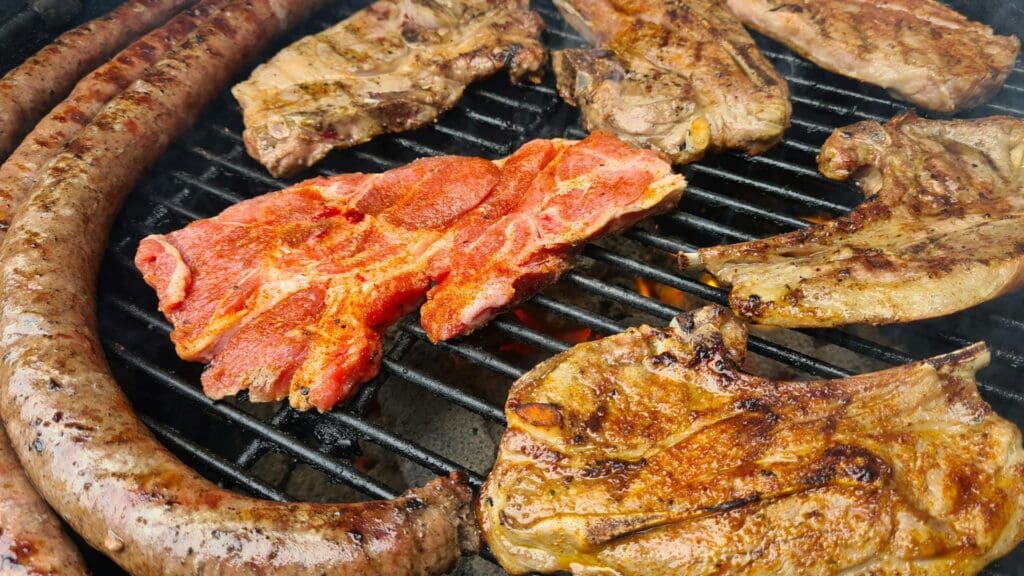
Braai is another style of food in South Africa, and it is the country’s defining social ritual of fire, meat, beers, brandy, and conversation, usually in that order. At a traditional braai, a variety of meats are cooked on an open fire.
The braai meat is served alongside salads and braaibroodjies (cheese, onion and tomato sandwiches, toasted on the fire.
Boerewors, the spiced farmer’s sausage seasoned with coriander and cloves, is the star of any braai, and it can also be a quick Friday night meal, often served on long breadrolls and topped with sheba (a mix of onion and tomato)
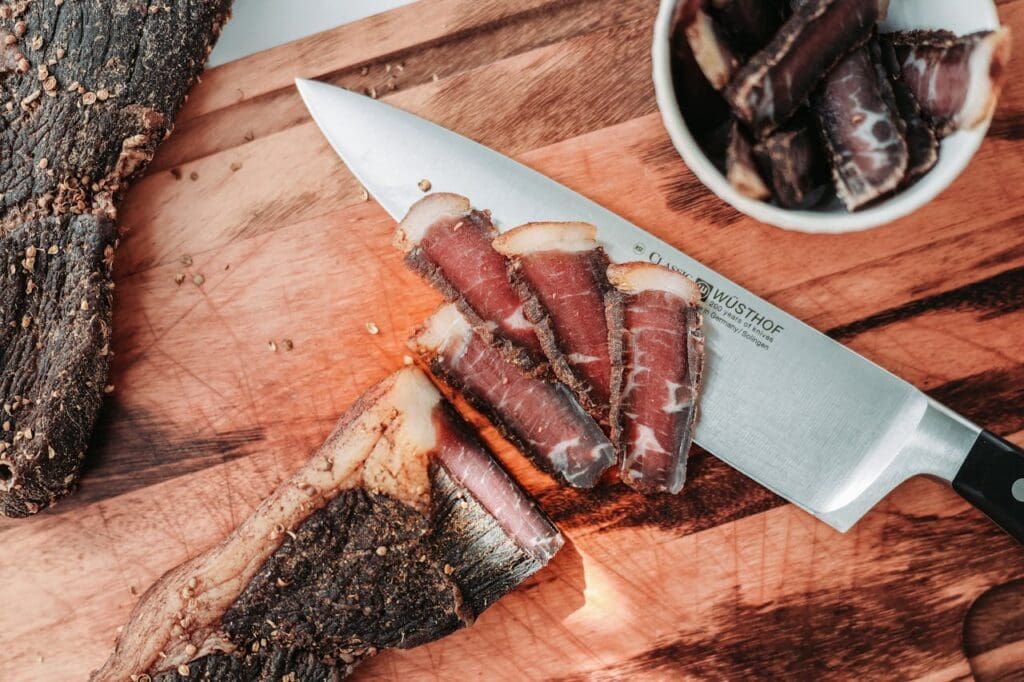
When travelling on the road, you will be introduced to Biltong, South Africa’s answer to jerky, but far more refined and far more delicious. It is considered a snack food, although most South Africans would eat it as a main meal if they could, and it is available everywhere from petrol stations to airport lounges.
Bunny chow, born in Durban’s Indian community in the 1940s, is a hollowed-out bread loaf filled with curry and one of the most satisfying things a hungry person can eat. Beware, though, this meal can be spicy and even if your eyes water, you can’t show those around you that you can’t handle the heat!
Food in South Africa also has a couple of to-die-for desserts, including Melktert, a Dutch-origin milk tart dusted with cinnamon, Peppermint Crisp Tart, a caramel, cream and peppermint chocolate mix, Malva Pudding, a baked cake with a caramel texture and cream sauce, and the humble but highly addictive Koeksister, which is a traditional Afrikaner pastry, doused in syrup.
What Sort of Food Do You Have on Safari?
Safari dining in South Africa is usually excellent, making it part of what makes the experience special.
At well-regarded private game lodges and camps, meals are taken outdoors when possible, sometimes in the bush itself around a fire, and the quality of the cooking is genuinely impressive.
Breakfasts tend to be substantial, designed for guests heading out on early morning game drives.
Lunches are often lighter, and dinners are the main event and include seasonal menus featuring local game meats such as springbok, kudu, and impala alongside fresh vegetables and carefully chosen South African wines.
Many lodges source directly from local farms and take particular pride in their wine lists.
Eating dinner under the open sky with the sounds of the African bush around you is an experience no restaurant setting can quite replicate.
What Sort of Food Do You Get in Cape Town?
Everything from a bowl of warm and spicy Cape Malay curry in Bo-Kaap to a twelve-course tasting menu overlooking the Atlantic.
The V&A Waterfront is lined with seafood restaurants, and the Winelands towns of Stellenbosch and Franschhoek are home to estate restaurants that rank among the country’s finest.
For something more casual, the city’s coffee shop culture is exceptional, and neighbourhood spots throughout De Waterkant, Woodstock, and Sea Point serve food that punches well above its price.
Cape Town also has one of the most developed craft gin and beer scenes in the southern hemisphere!

What Are Famous South African Restaurants?
La Colombe, set on the Silvermist organic wine estate above Constantia Nek, Salsify at The Roundhouse in Camps Bay, known for its ten-course seasonal menu and Atlantic views, and The Pot Luck Club, from chef Luke Dale Roberts, built around a sharing menu that covers all five flavour profiles, all appeared on the World’s 100 Best Restaurants 2025 list.
Fyn, in Cape Town’s city centre, also gets international praise for its Japanese-South African fusion. And Aubergine, one of the country’s most respected fine dining institutions since 1996, remains a benchmark for wine pairing and seasonal cooking.
What Are Popular South African Dishes and Foods?
Aside from the food in South Africa already mentioned, a few more, perhaps lesser-known dishes, are worth getting to know.
Potjiekos, a slow-cooked stew made in a three-legged cast iron pot over an open fire, Chakalaka a spiced vegetable relish which is Zulu in origin with Indian and Cape Malay influences, Pap, a maize meal porridge similar to polenta though much finer, and rooibos tea, grown only in South Africa’s Cederberg Mountains, are all foods and beverages that are popular throughout the country.

If a trip built around exceptional food, extraordinary landscapes, and warm hospitality has been sitting in the back of your mind, this may be the moment to plan a holiday.
The team at ATC knows this country intimately, and we are rather good at turning a wish list into something real.
Start mapping out your South Africa journey with us, and let the dinner table be part of the plan from the very beginning.
Bobotie is widely recognised as South Africa’s unofficial national dish. Its recipe traces back to a 1609 Dutch cookbook.
The strength of the US dollar against the South African rand means that even high-end restaurants, fine wines, and luxury lodge dining come in well below equivalent US prices.
While South African cuisine is traditionally meat-heavy, Cape Town in particular has a well-developed vegetarian and vegan dining scene. Most restaurants now accommodate dietary requirements without compromising on flavour or quality.
Pinotage, a grape variety grown nowhere else on earth, is South Africa’s most distinctive contribution to the wine world. It is a cross between Pinot Noir and Cinsault, developed here in 1925, and at its best it produces rich, smoky, deeply flavoured reds.
In well-touristed areas and established markets, yes. As with any destination, a degree of common sense applies, but South Africa’s main food tourism hubs are generally very safe for adventurous eating.